|
The Pyramids
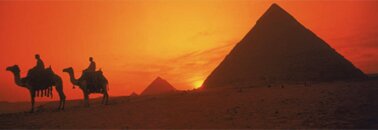
There are no more famous ancient sites within Egypt, or for that matter elsewhere in the world, than the Great Pyramids at Giza. They are, without question, the icon most associated with Egypt. They have been both the main destination for tourists, and a source of imaginative thought to the world for over three thousand years.
However, there are actually over 100 pyramids in Egypt, many of which are relatively unknown to anyone who is not an ancient Egypt enthusiast. All but a very few are grouped around and near the City of Cairo, just south of the Nile Delta. Otherwise, only one royal pyramid is known in southern Egypt (at Abydos), that being the one built by Ahmose, founder of the 18th Dynasty and Egypt's New Kingdom. It may have also been the last royal pyramid built in Egypt. While pyramids were, for the most part, tombs for the Pharaohs of Egypt, one must nevertheless question the reason that Egyptian rulers chose this particular shape, and for that matter, why they built them so large. Today, we believe that they chose the shape in order to mimic the Benben, a pyramid shaped stone found in the earliest of temples, which itself is thought to symbolize the primeval mound from which the Egyptians believed life emerged. This also connected the pyramid to the Sun God, as it was he, according to some of the ancient Egypt mythology, who rose from the primeval mound to create life.
As far the great size of many of the pyramids in Egypt, we can really only surmise that the Pharaohs were making a statement about their own power and perhaps, about the glory and strength of their country. However, it should also be remembered that many of the latter pyramids were not nearly as large as the Great Pyramids at Giza (and elsewhere). However, some mysteries remain, even in some of the best well known Pyramids. The most famous of them all, the Great Pyramid of Khufu, continues, year after year, to give up a few more secrets, and there doubtless remains much to learn from these Egyptian treasures. There may even be one or more pyramids yet to be discovered.
The Opera House
All Egyptian artistic groups admire the main Opera hall. It is certainly the largest, most beautiful and the most sophisticated of all theatres in Egypt. One can gain access to it through different entrances. Designed to seat 1,300 spectators, the hall rises on four levels, with two upper circles, one grand circle and seats near the stage,as well as a presidential box on the third levEl , which the guests of honor can reach by elevator from the entrance hall.
The seats in the stalls rise in tiers, at regular intervals, to the projection and control room, equipped for the screening of 16 and 35 millimeter films and allowing the installation of TV-cameras. Circles and boxes are not only elegantly designed, but also ensure excellent vision of the stage, from which none of the 1,300 spectators is at a distance exceeding 25 meters.
|









 Baron Hotel Heliopolis Cairo